TypeScript OOP: Classes, Inheritance & Abstract Classes
Learn how TypeScript uses classes, access modifiers, inheritance, and composition to organize reusable application logic.
Imagine you're building a food-ordering application.
Every tea order has a flavor, price, and sugar level. It also needs operations such as updating sugar, calculating prices, and preparing drinks.
You could create separate variables and functions for everything. But as the application grows, managing them becomes difficult.
What if we could group related data and behavior into one reusable structure?
That's the idea behind Object-Oriented Programming (OOP).
TypeScript supports JavaScript's class system and adds static type checking, access modifiers, and abstract classes to help developers model objects more clearly.
1. Classes and Constructors
A class is a blueprint for creating objects that contain related properties and methods.
class Tea {
  flavor: string;
  price: number;

  constructor(flavor: string, price: number) {
    this.flavor = flavor;
    this.price = price;
  }

  describe(): string {
    return `${this.flavor} tea costs ₹${this.price}`;
  }
}

const chai = new Tea("Masala", 25);

console.log(chai.describe());
// Masala tea costs ₹25
Here:
class Teadefines the structure and behavior.constructor()initializes each new instance.thisrefers to the instance on which the method is called.new Tea()creates an object.
TypeScript checks that required fields are initialized when strict property initialization is enabled. Fields can be initialized directly or assigned in the constructor.
Constructor parameter properties
TypeScript also provides shorthand for declaring and initializing class properties:
class Tea {
  constructor(
    public flavor: string,
    public price: number
  ) {}
}
This is equivalent in purpose to explicitly declaring the fields and assigning them inside the constructor.
Remember: A class groups data and behavior. A constructor initializes the object when an instance is created.
2. Access Modifiers: public, private and protected
Not every class property should be accessible from outside.
For example, users might be allowed to see the price of a tea but shouldn't directly modify internal accounting data.
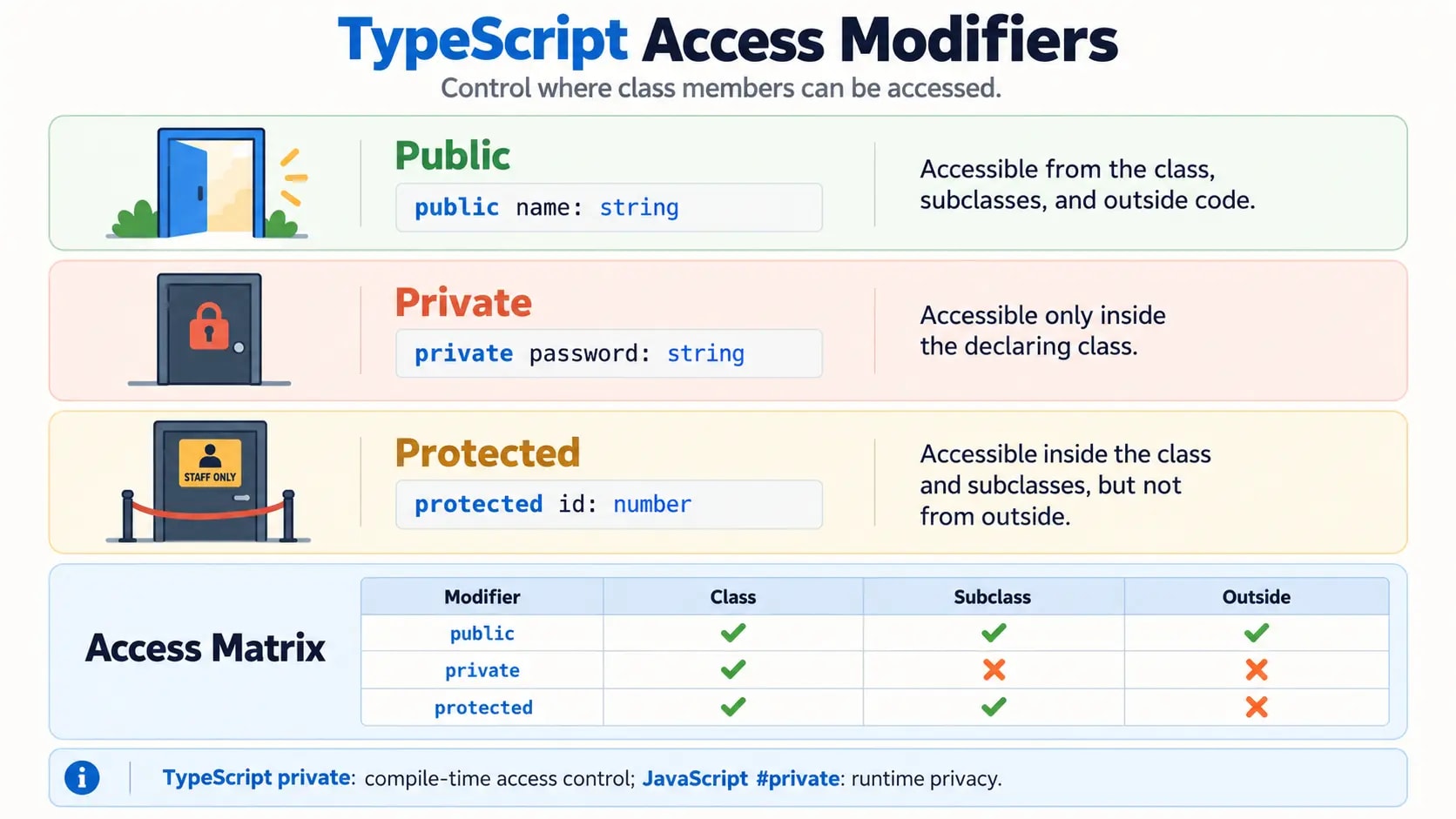
TypeScript provides three access modifiers.
Modifier | Inside class | Subclass | Outside class |
|---|---|---|---|
| Yes | Yes | Yes |
| Yes | No | No |
| Yes | Yes | No |
2.1 public — Accessible everywhere
class Tea {
  public flavor = "Masala";
}

const tea = new Tea();

console.log(tea.flavor); // Valid
public is the default visibility modifier, so writing it is optional.
2.2 private — Accessible only inside the class
class Tea {
  private costPrice = 15;

  getCost(): number {
    return this.costPrice;
  }
}

const tea = new Tea();

console.log(tea.getCost()); // 15

// tea.costPrice; // Type error
Private members cannot be directly accessed from outside the declaring class or from subclasses.
2.3 protected — Accessible inside subclasses
class Drink {
  protected shopName = "Chai Cafe";
}

class Tea extends Drink {
  showShop(): string {
    return this.shopName;
  }
}

const tea = new Tea();

console.log(tea.showShop()); // Chai Cafe

// tea.shopName; // Type error
A subclass can access protected members inherited from its parent.
TypeScript private vs JavaScript #private
There's an important distinction.
class Account {
  private balance = 100;
  #pin = 1234;
}
TypeScript
privateis primarily a compile-time access restriction.JavaScript
#pinis a native private field with runtime-enforced access restrictions.
If you need actual JavaScript runtime privacy, #private fields are the stronger option.
3. readonly: Preventing Reassignment
Some class properties should not change after initialization.
For example, a unique order ID should remain the same throughout the object's lifecycle.
class TeaOrder {
  readonly orderId: string;

  constructor(orderId: string) {
    this.orderId = orderId;
  }
}

const order = new TeaOrder("ORD-101");

// order.orderId = "ORD-102"; // Type error
A readonly field can be initialized at declaration or assigned within the constructor.
After initialization, TypeScript prevents reassignment through that property.
Important: readonly is enforced by TypeScript's type checker. It doesn't automatically freeze the object at runtime.
4. Getters and Setters: Controlled Property Access
Sometimes we want to expose a property while controlling how it is read or changed.
Imagine allowing customers to update the sugar level of their tea, but restricting it to a valid range.
class Tea {
  private _sugarLevel = 2;

  get sugar(): number {
    return this._sugarLevel;
  }

  set sugar(value: number) {
    if (value < 0 || value > 5) {
      throw new Error("Sugar must be between 0 and 5");
    }

    this._sugarLevel = value;
  }
}

const tea = new Tea();

tea.sugar = 3;           // Calls setter
console.log(tea.sugar); // Calls getter: 3
Here:
getreads the value.setcontrols how the value is updated.Validation prevents invalid assignments at runtime.
This demonstrates encapsulation: keeping internal state controlled through a defined interface.
Use getters and setters when you need validation, computed values, or controlled access. Simple public properties don't always need them.
5. Static Members: Belonging to the Class
Normally, properties belong to individual objects.
But some values should be shared at the class level.
class Tea {
  static shopName = "Chai Cafe";

  constructor(public flavor: string) {}
}

console.log(Tea.shopName); // Chai Cafe
Notice that we access shopName through Tea, not through an instance.
const tea = new Tea("Masala");

// tea.shopName; // Type error
Static members are useful for shared constants, factory methods, and class-level utilities.
Remember: Instance members belong to objects. Static members belong to the class itself.
6. Inheritance: Reusing Parent Class Behavior
Inheritance allows one class to reuse or extend the behavior of another.
It represents an is-a relationship.
For example, Tea is a kind of Drink.
class Drink {
  constructor(public name: string) {}

  serve(): void {
    console.log(`Serving ${this.name}`);
  }
}

class Tea extends Drink {
  brew(): void {
    console.log(`Brewing ${this.name}`);
  }
}

const tea = new Tea("Masala Tea");

tea.brew();  // Brewing Masala Tea
tea.serve(); // Serving Masala Tea
The Tea class inherits the public behavior of Drink through extends.
Method overriding
A subclass can provide its own version of an inherited method.
class SpecialTea extends Drink {
  override serve(): void {
    console.log(`Serving special ${this.name}`);
  }
}
The override keyword makes the intention explicit and helps TypeScript detect incorrect overrides.
Inheritance is useful when classes share a genuine relationship and common behavior.
However, deep inheritance hierarchies can make applications difficult to maintain.
7. Abstract Classes: Defining a Common Contract
Imagine your application supports tea, coffee, and juice.
Every drink must implement its own preparation logic, but you also want to share common functionality.
An abstract class provides a base structure that cannot be instantiated directly.
abstract class Drink {
  constructor(public name: string) {}

  abstract prepare(): void;

  serve(): void {
    console.log(`Serving ${this.name}`);
  }
}

class Tea extends Drink {
  prepare(): void {
    console.log(`Brewing ${this.name}`);
  }
}

const tea = new Tea("Masala Tea");

tea.prepare();
tea.serve();
The abstract method prepare() has no implementation in the base class.
Concrete subclasses must implement it.
You cannot directly create an instance using new Drink() in type-checked TypeScript.
Abstract class vs interface
Abstract class | Interface |
|---|---|
Can contain implemented methods | Defines type contracts |
Can hold shared state | Doesn't create runtime state |
Supports constructors | No implementation constructor |
Exists as a JavaScript class at runtime | Erased from JavaScript output |
When to use an abstract class: When related subclasses need both a common contract and shared implementation.
Use an interface when you only need to define a contract without sharing class implementation.
8. Composition vs Inheritance
One of the most useful OOP design decisions is choosing between inheritance and composition.
Inheritance: Is-a relationship
class Drink {
  serve() {
    console.log("Serving drink");
  }
}

class Tea extends Drink {}
Tea is a Drink.
Composition: Has-a relationship
Composition means building a class using other objects.
class Heater {
  heatWater(): void {
    console.log("Heating water...");
  }
}

class TeaMaker {
  constructor(private heater: Heater) {}

  makeTea(): void {
    this.heater.heatWater();
    console.log("Brewing tea...");
  }
}

const maker = new TeaMaker(new Heater());

maker.makeTea();
Here, TeaMaker has a Heater.
It doesn't need to inherit from Heater because a tea maker isn't a type of heater.
Why composition is useful
Composition lets us replace individual dependencies without redesigning an entire inheritance hierarchy.
For example, TeaMaker could use a different heater implementation if its contract remained compatible.
This is particularly useful in backend services, dependency injection, and application architectures where components need to be independently testable.
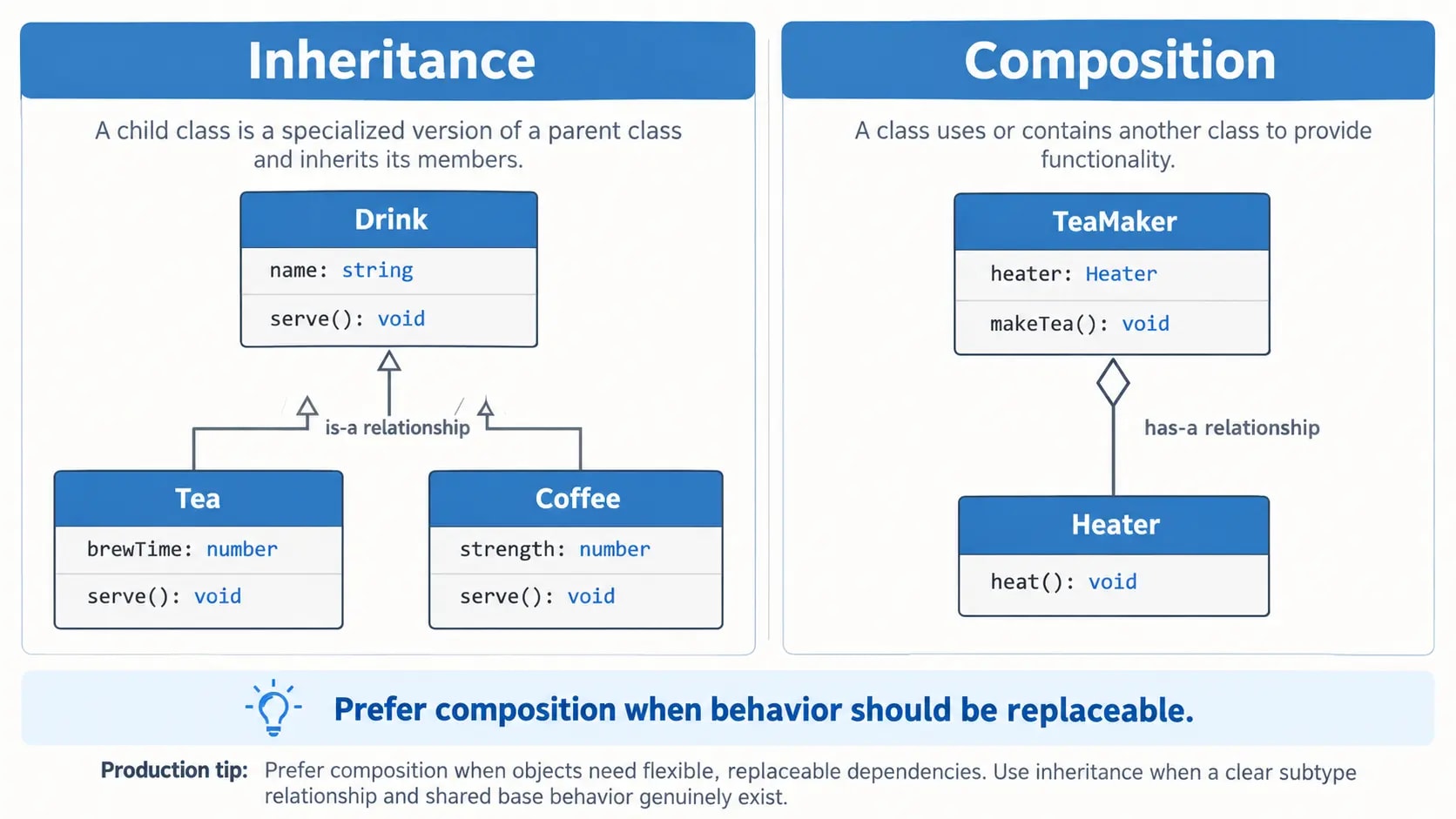
Production tip: Prefer composition when objects need flexible, replaceable dependencies. Use inheritance when a clear subtype relationship and shared base behavior genuinely exist.
9. Common Mistakes
Mistake | Better approach |
|---|---|
Making every property public | Control access where necessary |
Assuming | Use JavaScript |
Using getters/setters for every simple field | Add them when behavior or validation is required |
Using deep inheritance hierarchies | Consider composition |
Using abstract classes for type-only contracts | Consider interfaces |
Assuming | Remember it provides static protection |
10. TypeScript Interview Questions
Q1. What is the purpose of a constructor?
A constructor initializes a class instance. It can receive parameters, assign properties, and set up the object's initial state.
Q2. What is the difference between public, private, and protected?
public members are accessible everywhere. private members are accessible within the declaring class. protected members are accessible within the class and its subclasses.
Q3. What is the difference between TypeScript private and JavaScript #private?
TypeScript's private modifier provides static access restrictions, while JavaScript #private fields enforce runtime privacy.
Q4. What is an abstract class?
An abstract class defines a base structure that cannot be directly instantiated in type-checked TypeScript. It can provide shared implementations and abstract members that concrete subclasses must implement.
Q5. What is the difference between static and instance members?
Static members belong to the class itself, while instance members belong to individual objects created from the class.
Q6. Why is composition often preferred over inheritance?
Composition allows classes to use replaceable dependencies without becoming tightly coupled through a deep inheritance hierarchy, improving flexibility and testability.
11. Quick Revision Notes
Core concepts
Concept | Remember |
|---|---|
| Blueprint for creating objects |
| Initializes an instance |
| Refers to the current instance |
| Accessible from anywhere |
| Accessible within declaring class |
| Accessible in class and subclasses |
| Prevents reassignment through type checking |
| Controlled property access |
| Member belongs to the class |
| Class inheritance |
| Explicitly overrides inherited member |
| Defines non-instantiable base class contracts |
Composition | Has-a relationship |
Inheritance | Is-a relationship |
Essential syntax
Class and constructor
class User {
  constructor(public name: string) {}
}
Private field
class Account {
  #balance = 100;
}
Static member
class Config {
  static appName = "ConsistCode";
}
Inheritance
class Animal {}
class Dog extends Animal {}
Abstract class
abstract class Shape {
  abstract area(): number;
}
Composition
class Engine {}

class Car {
  constructor(private engine: Engine) {}
}
Five things to remember
Classes combine state and behavior into reusable objects.
Access modifiers control which parts of a class can be accessed.
staticmembers belong to the class rather than individual instances.Abstract classes define common behavior and required subclass implementations.
Prefer composition when dependencies need to be flexible and replaceable.
Final takeaway
Object-Oriented Programming helps organize complex applications by grouping related data and behavior.
TypeScript strengthens JavaScript's class system through static type checking, access modifiers, and abstract contracts.
However, good OOP is not about creating more classes or inheritance layers.
Use classes where they make responsibilities clearer, encapsulate state when necessary, and prefer simple, flexible designs over unnecessary complexity.
Further Reading
TypeScript Classes: https://www.typescriptlang.org/docs/handbook/2/classes.html
TypeScript Object Types: https://www.typescriptlang.org/docs/handbook/2/objects.html
TypeScript Interfaces: https://www.typescriptlang.org/docs/handbook/2/everyday-types.html