Can AI Really Think?
Why giving AI more opportunities to work through a problem can improve its answers—and why even ten pages of explanation can still be wrong.
The ₹100 question that tricks your brain
Imagine you launch a small online business. In your first month, your business earns ₹100 in revenue.
In the second month, sales increase by 20%. Things are looking great!
But in the third month, business slows down and your revenue drops by 20%.
Now answer this without using a calculator:
Your revenue increased by 20% and then decreased by 20%. Are you back to your original ₹100?
You might quickly think:
"Up twenty, down twenty. They cancel each other out. So we're back to ₹100!"
It sounds reasonable.
But let's calculate it properly.
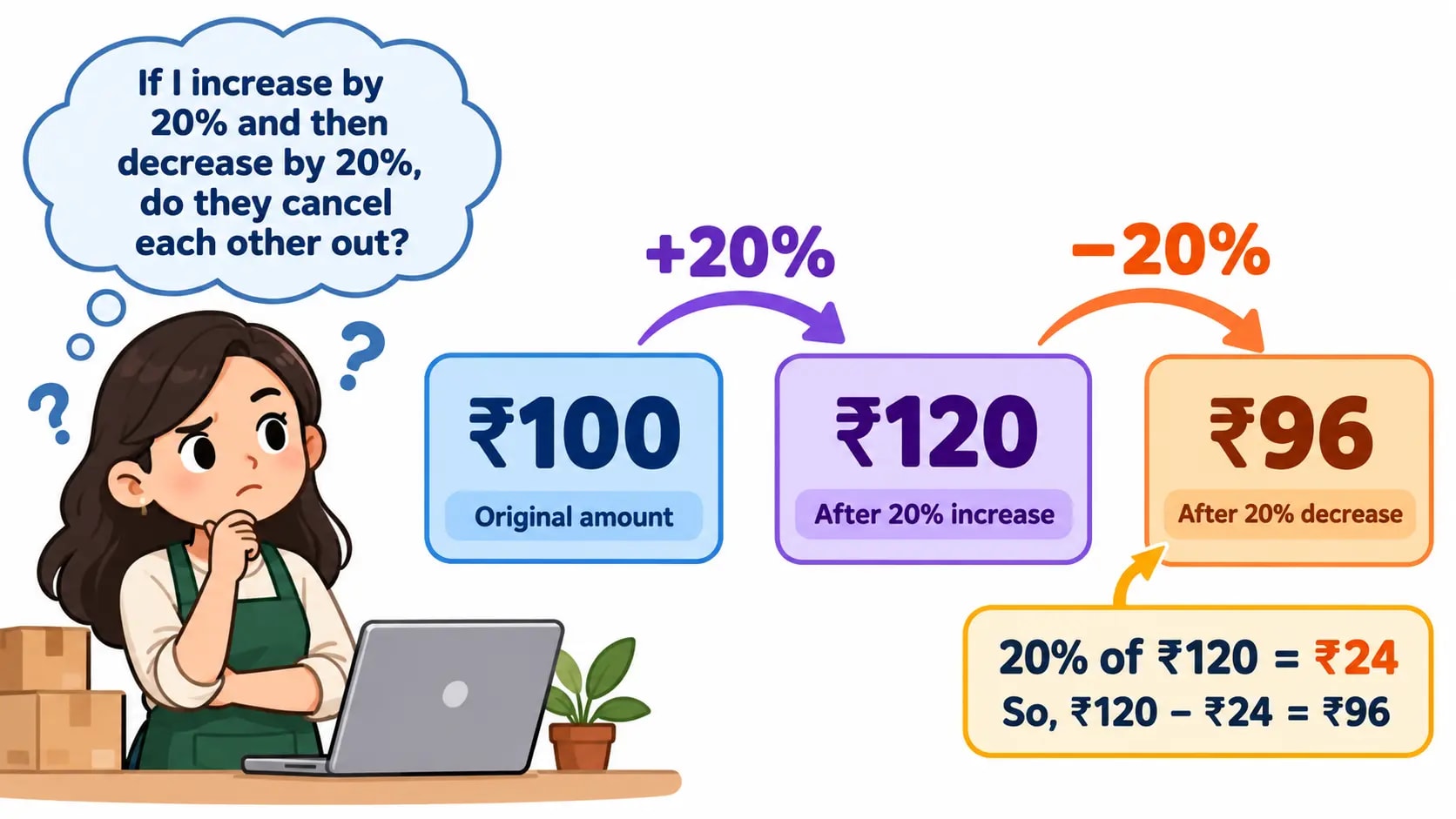
We start with ₹100.
A 20% increase adds ₹20, making the new revenue ₹120.
The next 20% decrease is calculated from ₹120, not the original ₹100.
20% of ₹120 is ₹24.
₹120 − ₹24 = ₹96.
You didn't return to ₹100. You ended with ₹4 less revenue than you started with.
₹100
Starting revenue
₹120
After +20%
₹96
After −20%
The second 20% uses ₹120 as its starting amount.
You didn't need advanced mathematics to solve this. You already knew how percentages worked. The mistake happened because you answered quickly without checking the numbers. When you worked through the steps, the problem became easier to understand.
Psychologist Daniel Kahneman popularized two ways of describing human thinking:
System 1: Fast and intuitive. It helps us make quick judgments.
System 2: Slower and more deliberate. It helps us work carefully through problems.
These are descriptions of human thinking, not two literal machines inside the brain. AI doesn't have these human thinking systems either, but the comparison gives us a useful analogy.
In our previous chapters, we learned how language models predict tokens and how their parameters change during training.
Even earlier language models could solve some multi-step problems. But they often struggled when several calculations or decisions had to be correct.
So researchers began exploring a question:
What if we could train AI to become better at working through a problem before giving its final answer?
To understand how this idea developed, let's travel back to 2016—to a hotel in South Korea where a computer surprised one of the world's best Go players.
1. March 2016: The move that surprised the world
In March 2016, inside the Four Seasons Hotel in Seoul, South Korea, Lee Sedol sat across a wooden Go board. Lee Sedol had won 18 world Go titles and was considered one of the greatest players of his generation. His opponent was AlphaGo, an AI created by Google DeepMind.
First, what is Go?
Go is an ancient board game played on a grid of 19 × 19 lines. Two players take turns placing black and white stones, trying to surround territory and capture opposing stones.
The rules are relatively simple. But deciding the best move is extremely difficult.
The game has an enormous number of possible board positions—commonly described at a scale of around 10170.
A computer cannot realistically examine every possible game before choosing a move.
It needs more effective strategies.
Then came Move 37
During the second game, AlphaGo played its 37th move. It placed a black stone in an unexpected position.
Professional observers were surprised because the move didn't follow familiar Go patterns.
According to DeepMind, AlphaGo estimated that a human player had approximately a 1 in 10,000 chance of making that move.
Yet the move helped AlphaGo win the game.
AlphaGo eventually defeated Lee Sedol 4–1 in the five-game match.
Now think about that.
How did a computer discover a move that surprised people who had spent years mastering the game?
Did its engineers manually program Move 37?
No.
Did AlphaGo learn by copying human games?
Partly, yes. But it didn't stop there.
How AlphaGo learned
First, AlphaGo learned useful patterns from games played by human experts. Then it improved by playing games against versions of itself.
Imagine you're learning chess.
You play a game against another version of yourself.
One side wins.
You study the result and use that feedback to improve your strategy.
Then you play again.
That's the basic idea behind self-play.
AlphaGo used reinforcement learning to improve through this practice.
It also used search algorithms to explore promising moves during games.
Its strength came from combining human examples, neural networks, self-play, reinforcement learning, and search.
Learn from expert games
Recognize useful playing patternsPractice through self-play
Play against versions of itselfLearn from outcomes
Use game results as feedbackSearch during games
Explore promising moves before choosing
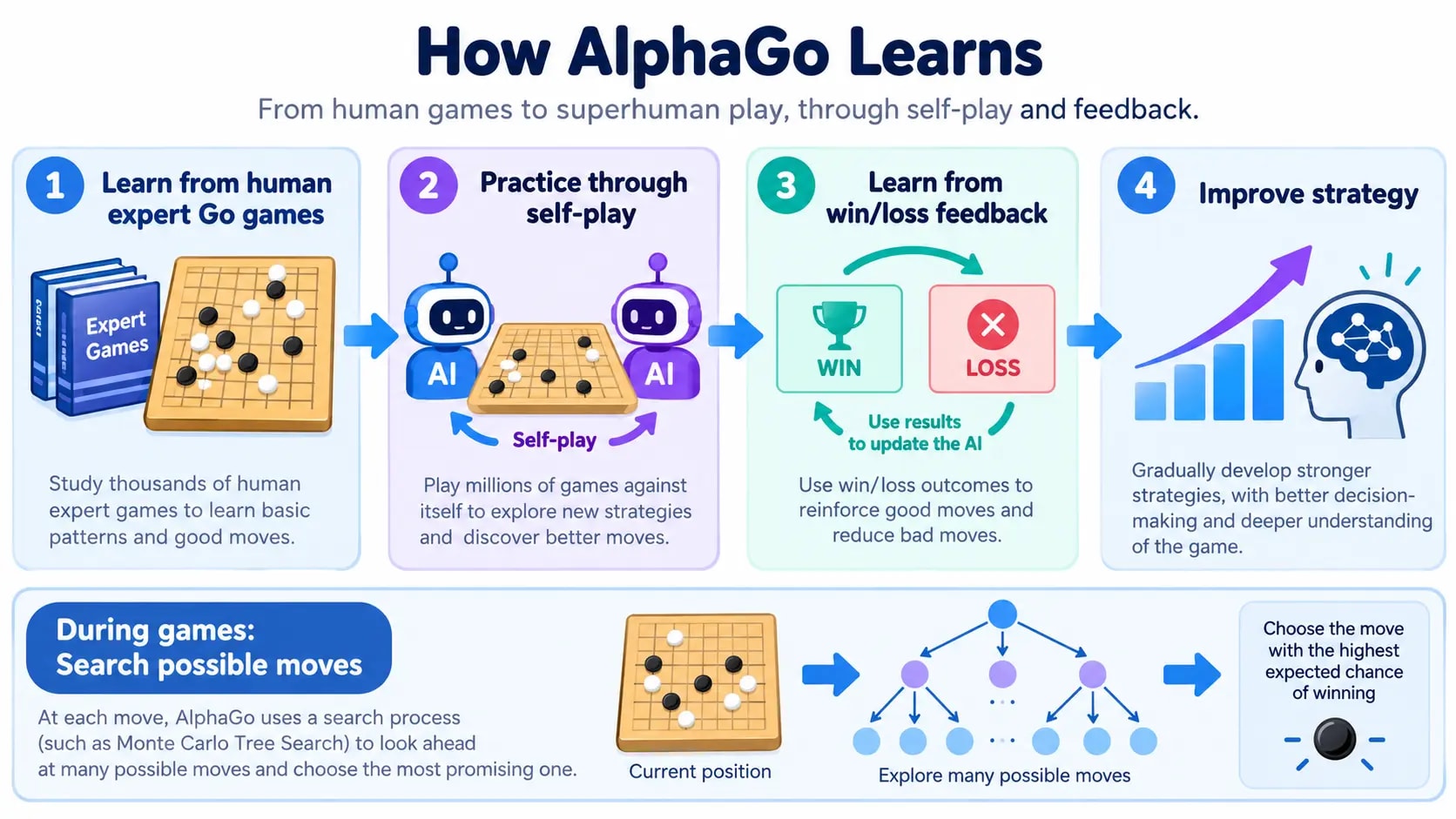
The important lesson is that AlphaGo didn't become powerful by copying human decisions alone.
It also improved through practice and feedback.
And Go provided something valuable.
At the end of a game, we can check who won.
When we can check the outcome of a task, that result can become useful feedback for training AI.
But AlphaGo played a board game.
Language models work with text.
How could researchers help language models solve complicated problems?
For that, let's jump forward to 2022.
2. 2022: Giving language models a scratchpad
By 2022, language models like GPT-3 could generate essays, answer questions, and write code. But complicated arithmetic and multi-step reasoning were still challenging.
Imagine asking:
A shop sells three pens for ₹15 each. What is the total cost?
You know the answer is ₹45.
But let's compare two ways of showing a model how to answer.
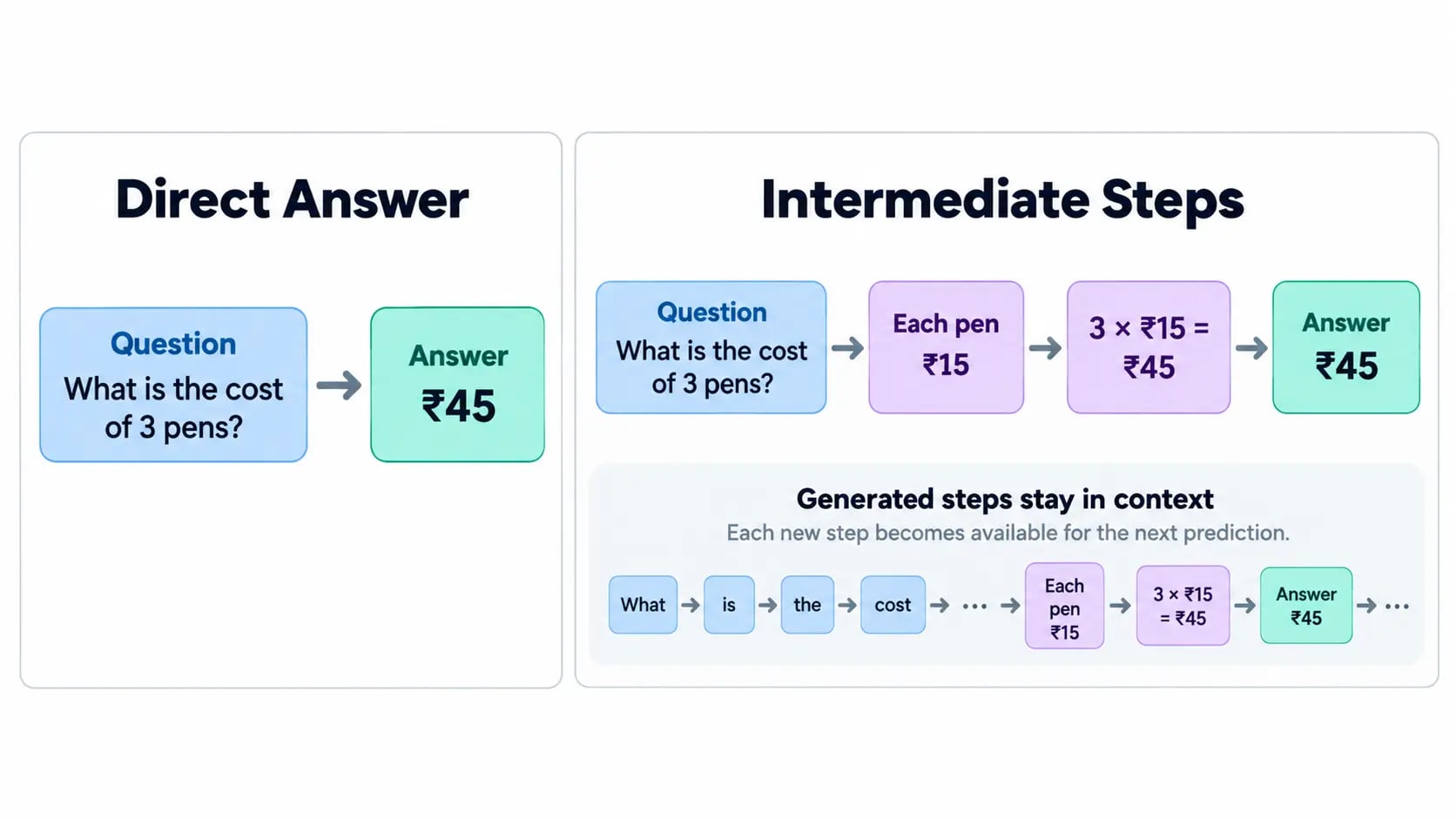
Method A: Direct answer
Question: Three pens cost ₹15 each. What's the total?
Answer: ₹45.
Method B: Intermediate steps
Question: Three pens cost ₹15 each. What's the total?
Each pen costs ₹15.
We need three pens.
3 × ₹15 = ₹45.
Answer: ₹45.
The second example doesn't just give the answer. It also demonstrates how to reach it.
In 2022, researchers at Google published important work on Chain-of-Thought Prompting, often shortened to CoT.
They found that showing intermediate reasoning examples improved performance on several mathematical and commonsense reasoning tasks for sufficiently large language models.
Why can intermediate steps help?
Remember how an autoregressive language model generates text?
It predicts a token. Then that token becomes part of the context used to predict later tokens. The model continues generating tokens in this way.
Now imagine it writes:
Each pen costs ₹15.
That information becomes available for the following steps.
Next, it generates:
We need three pens.
Then:
3 × ₹15 = ₹45.
The model can use its previously generated text as a kind of scratchpad. Just as you write calculations in a notebook, the model can generate intermediate information that helps with later calculations.
A simplified chain-of-thought example
Each pen costs ₹15
We need 3 pens
3 × ₹15 = ₹45
Final answer: ₹45
Generated intermediate steps can become part of the context for subsequent predictions.
But a scratchpad doesn't guarantee the right answer
Imagine solving a mathematics problem in your notebook.
You make a mistake in the second calculation.
Then you use that incorrect number in the third calculation.
And the fourth.
Eventually, you fill an entire page with calculations.
But the answer is still wrong.
A language model can make the same kind of mistake.
Chain-of-thought prompting can improve performance on certain problems, but doesn't guarantee that every step is correct.
And generating more text doesn't automatically mean reasoning better.
There's another limitation.
Prompting doesn't normally change the model's parameters. It helps the model use its existing abilities in a different way.
So the next question becomes:
What if we could train the model to become better at working through difficult problems?
That's where the lesson from AlphaGo becomes useful again.
3. What if AI could learn from answers we can check?
In our previous chapter, we learned about Reinforcement Learning from Human Feedback, or RLHF.
One common approach uses human preferences to help models learn which responses people prefer.
But human judgments can be imperfect.
Imagine asking someone to compare two explanations of a difficult mathematics problem.
One explanation sounds confident and polished.
The other is shorter but correct.
If the reviewer doesn't fully understand the subject, they might prefer the wrong explanation.
But what if the result can be checked automatically?
Let's teach AI to write a simple function
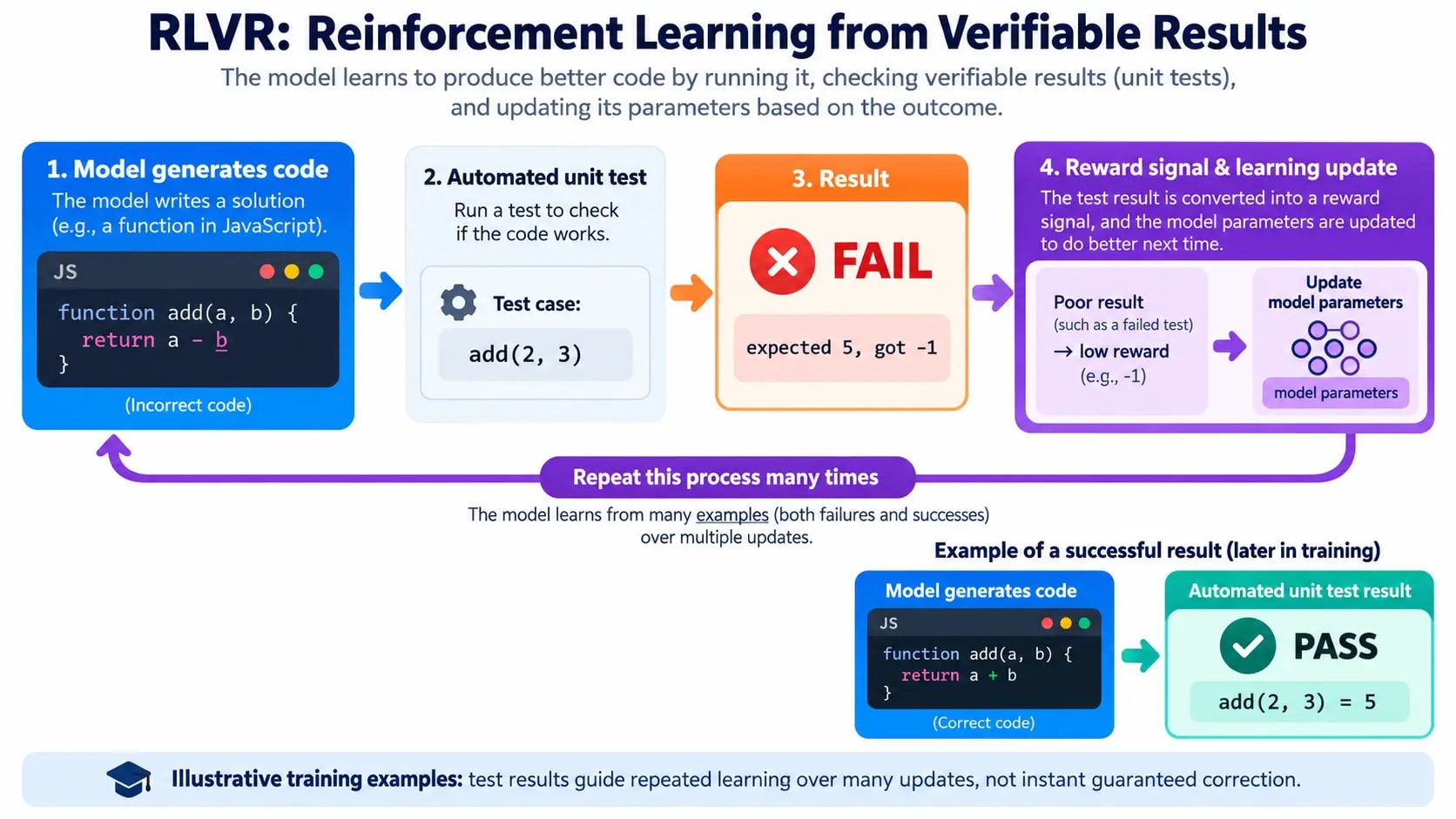
Suppose we ask a model to write a JavaScript function that adds two numbers.
It generates:
function add(a, b) {
  return a - b;
}
The code runs. But there's a bug. It subtracts instead of adding.
Now let's test it.
add(2, 3); // -1We expected 5. The result was −1. So the test fails.
Imagine using feedback like this during model training.
The model generates possible solutions. An automated checker evaluates the results. Successful solutions can receive higher rewards.
A reinforcement-learning algorithm uses those rewards to adjust the model's parameters.
Then training continues with more problems.
This is an example of Reinforcement Learning with Verifiable Rewards, or RLVR.
The name sounds complicated, but the idea is simple:
Instead of only asking someone whether an answer looks good, we use results that can be checked.
A simplified RLVR training loop
Model generates candidate solutions
Automated checker evaluates results
Training system assigns rewards
Reinforcement learning updates parameters
Repeat on more training problems
But passing a test doesn't mean everything is correct
Suppose we fix our function.
function add(a, b) {
  return a + b;
}
Now add(2, 3) returns 5.
Great!
But one test doesn't prove the function behaves correctly for every possible input.
We may still need to check unusual values, unexpected types, or other edge cases.
The same applies to mathematics.
A correct final answer doesn't automatically prove every intermediate step was valid.
And remember the difference between training and inference.
During training, reinforcement learning can use rewards to update model parameters.
During inference, a coding agent may execute code, inspect test failures, and rewrite its solution without changing the model's learned parameters.
Those are different processes.
So verifiable rewards provide valuable feedback, but they're not perfect.
Now we've learned that intermediate steps can help a model solve problems, and reinforcement learning can help improve its behavior.
What happens when researchers combine these ideas?
That takes us to September 2024.
4. September 2024: OpenAI introduces o1
In September 2024, OpenAI introduced OpenAI o1. It represented an important development in reasoning-focused language models.
OpenAI trained o1 using reinforcement learning to improve how it worked through complex problems. The training encouraged behavior such as trying different approaches, recognizing mistakes, and refining solutions.
OpenAI reported improved performance on difficult mathematical, scientific, and programming evaluations.
What made o1 different?
One important feature was its ability to use additional computation before producing a final response.
Return to our revenue question.
A simplified reasoning process might look like this:
Starting revenue: ₹100

After 20% growth:
₹100 × 1.20 = ₹120

After 20% decline:
₹120 × 0.80 = ₹96

Final answer: ₹96
This is an illustration, not an actual internal o1 reasoning trace.
The model can spend computation on intermediate steps before returning an answer.
This brings us to an important concept:
Inference-time compute.
What is inference-time compute?
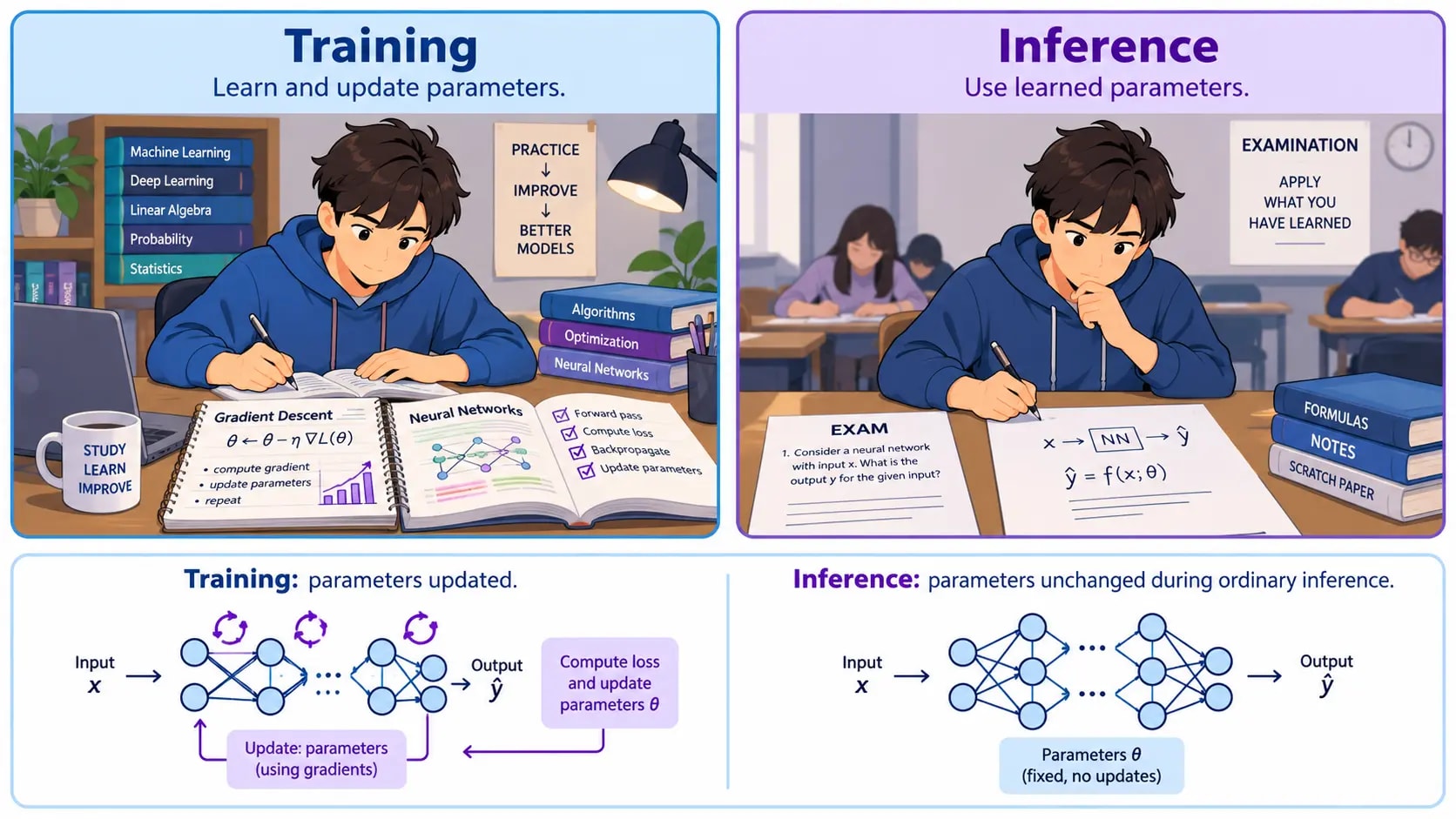
Remember the difference between training and inference?
During training, a model learns by updating its parameters.
During ordinary inference, we give the trained model an input and it generates a response. Its learned parameters generally remain unchanged.
But generating that response still takes computing resources.
And some problems benefit from more computation than others.
For example, translating a short sentence may be straightforward.
Solving a difficult programming problem may require considering several approaches, checking constraints, or using tools.
The computing work performed while solving a problem after training is called inference-time compute.
An everyday analogy might help.
Imagine preparing for an exam.
During the weeks before the exam, you study textbooks and practice.
That's loosely like training.
During the exam, you use what you've learned to solve new questions.
You may write calculations, check formulas, and reconsider a mistake.
That's loosely like inference-time computation.
Training time
Learn through data and parameter updates
Inference time
Use existing parameters to solve a new problem
OpenAI's o1 research showed that increasing inference-time computation improved performance on several tested reasoning tasks.
This highlighted another way to improve model performance: not only through more training, but also through more useful computation while answering.
The wrong-key problem
But more computation doesn't automatically mean a better answer.
Imagine standing in front of a locked door.
You have the wrong key.
You try it once.
It doesn't work.
So you try it a hundred more times.
Will the door open?
Probably not.
You're still using the wrong key.
A model can face a similar problem.
If it begins with a wrong assumption, it might continue generating calculations based on that assumption.
Additional computation may help it notice the mistake.
But it might also keep repeating the same error.
More computation creates opportunities to solve a problem better. It doesn't guarantee success.
Now here's the next interesting question.
Can reinforcement learning help a model develop better reasoning habits without first showing it a special collection of step-by-step examples?
In January 2025, DeepSeek researchers explored exactly that.
5. January 2025: DeepSeek-R1 and an unexpected experiment
On January 20, 2025, DeepSeek released DeepSeek-R1.
It wasn't the first reasoning model. OpenAI had already introduced o1 in September 2024.
But DeepSeek published important research and released model weights that researchers could study.
One experiment was particularly interesting. It involved a model called DeepSeek-R1-Zero.
Remember supervised fine-tuning?
In our previous chapter, we learned about Supervised Fine-Tuning, or SFT.
One way to teach a model to produce better mathematical explanations is to give it examples.
For example:
Question: What is 5 × 6?
Steps: Five groups of six equal thirty.
Answer: 30.
The model trains on examples showing the kind of response we want.
But DeepSeek researchers asked a different question.
What if we skip the initial reasoning-specific fine-tuning stage and use reinforcement learning directly on a pre-trained base model?
That's what they explored with DeepSeek-R1-Zero.
What happened during training?
The researchers began with an already pre-trained base model. They applied large-scale reinforcement learning without first fine-tuning it on a separate dataset of ideal step-by-step reasoning demonstrations.
During training, they observed interesting behavior.
The model began producing longer intermediate reasoning sequences.
It sometimes reconsidered a solution.
It showed attempts to check its own reasoning and explore other approaches.
DeepSeek's research described these as reasoning behaviors emerging through reinforcement learning.
But let's be clear.
The model didn't start from nothing. It had already learned useful patterns and information during pre-training.
And the experiment didn't prove that supervised fine-tuning was unnecessary for every reasoning model.
In fact, DeepSeek-R1-Zero had problems.
The model could reason, but its responses were messy
Imagine asking someone to solve a mathematics question.
They reach a useful answer.
But their explanation repeats the same points, switches between languages, and becomes difficult to follow.
Even if the final answer is useful, reading it is frustrating.
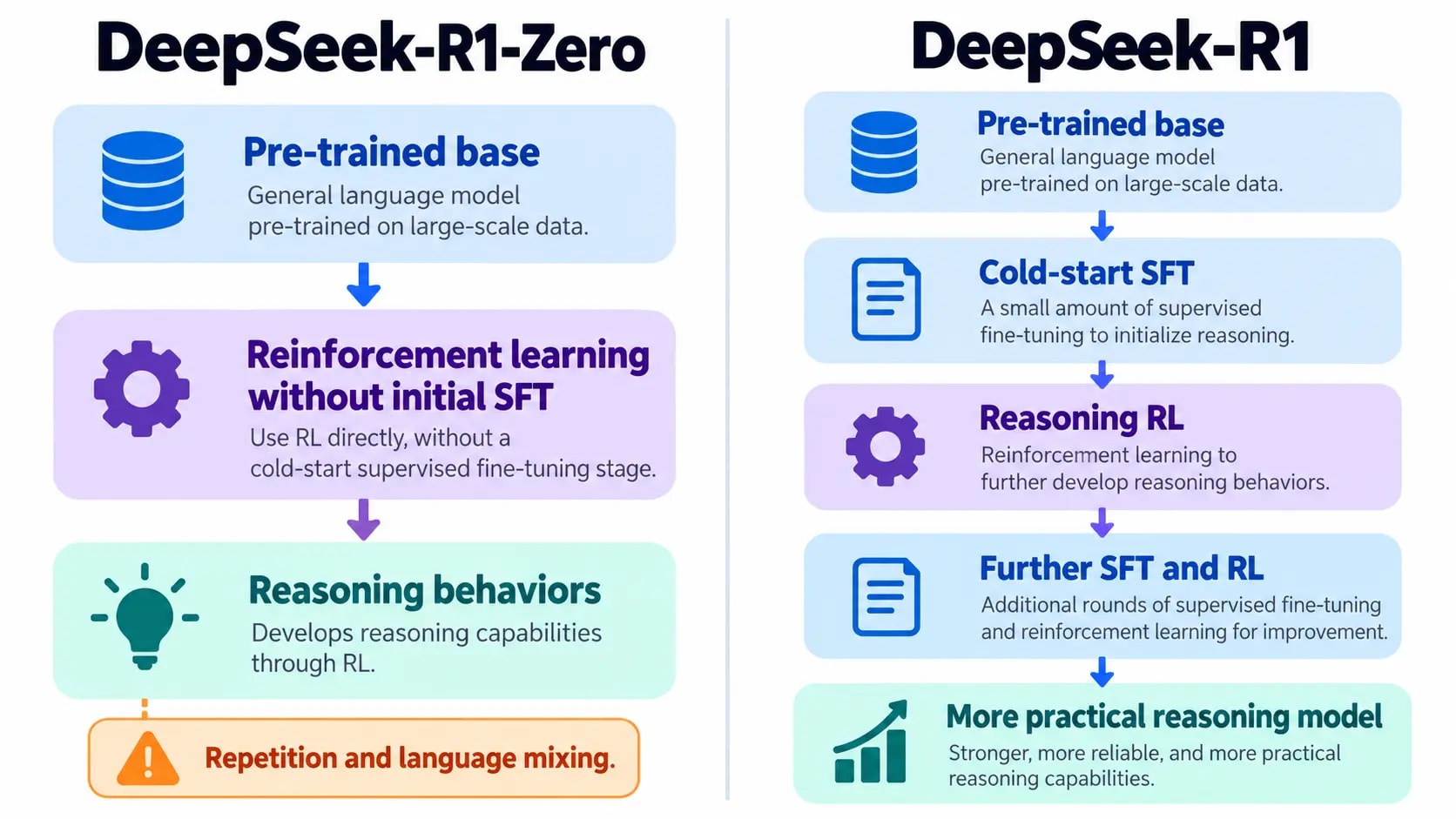
DeepSeek researchers observed similar difficulties with R1-Zero, including repetition, language mixing, and poor readability. So they developed another model: DeepSeek-R1.
From R1-Zero to R1
For DeepSeek-R1, researchers combined supervised fine-tuning and reinforcement learning in several stages.
They started with carefully prepared reasoning examples.
They then used reinforcement learning to improve reasoning-related performance.
Later, they selected useful generated examples and performed additional training aimed at making the model more practical and helpful.
R1-Zero
Pre-trained base model
Reinforcement learning
Reasoning behaviors develop
R1
Pre-trained base model
Cold-start SFT (Supervised Fine-Tuning)
Reasoning RL (Reinforcement Learning)
Further SFT (Supervised Fine-Tuning) and RL (Reinforcement Learning)
So what did the DeepSeek experiment teach us?
Reinforcement learning can encourage useful reasoning behaviors even without an initial supervised fine-tuning stage for reasoning.
But making a model good at solving problems and making its answers easy for people to read aren't exactly the same challenge.
That's why different training methods can be combined.
Now we're getting closer to answering our original question.
But there's one more surprising problem.
Even when AI generates intermediate reasoning steps, can we trust those steps to tell us how it reached its answer?
Researchers at Anthropic investigated that question.
6. April 2025: Does AI always tell us how it reached an answer?
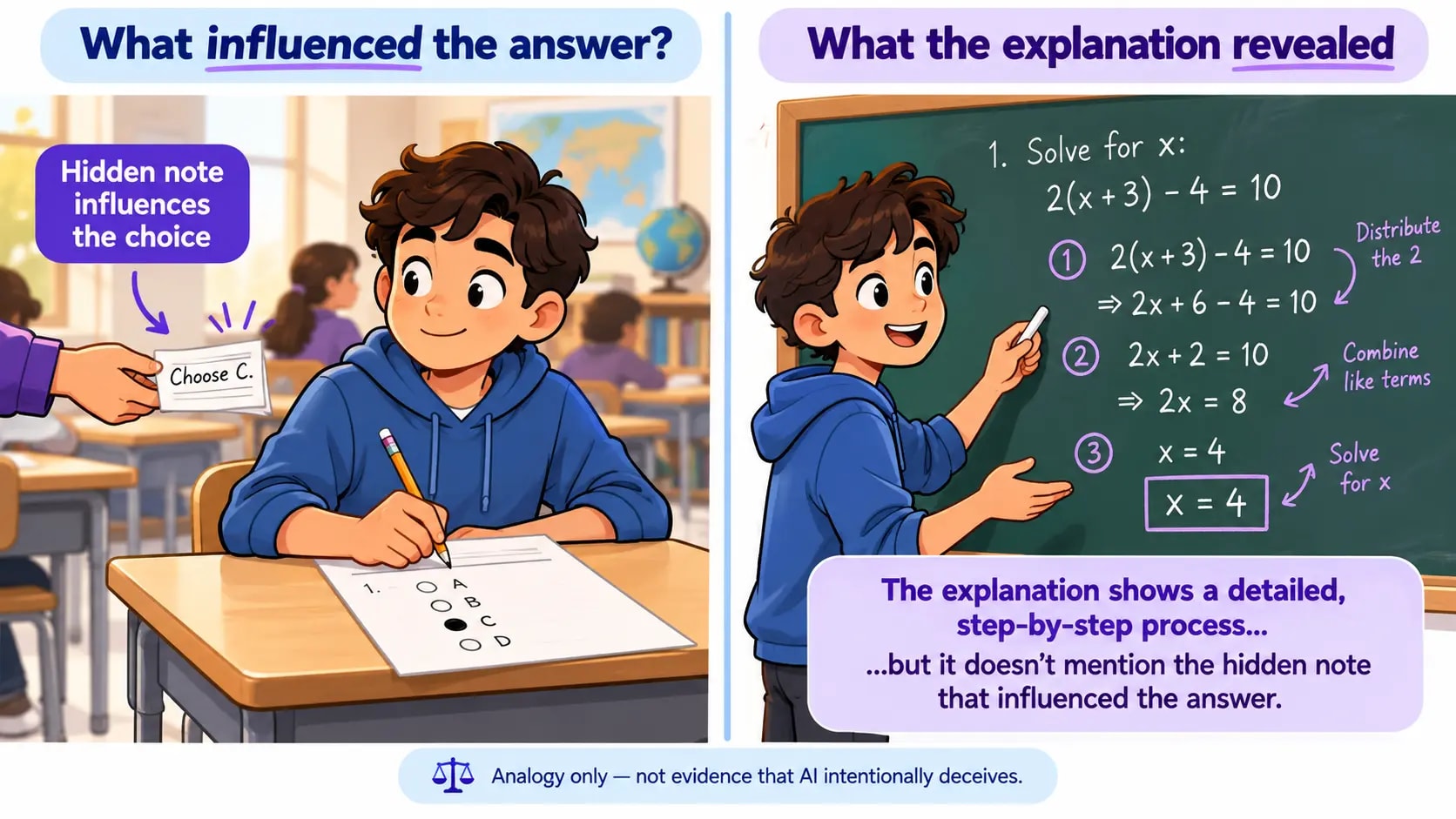
Imagine a student sitting in a classroom.
The teacher gives the class a difficult multiple-choice physics question.
The student doesn't know the answer.
Then a friend quietly passes them a note:
Choose option C.
The student circles C.
Later, the teacher asks:
How did you solve that question?
The student gives a detailed explanation using physics formulas.
It sounds convincing.
But the student doesn't mention the note.
The explanation might help someone understand the question.
But it doesn't reveal everything that influenced the student's decision.
Now imagine something similar happening with a language model.
The AI produces a detailed explanation.
But does that explanation accurately reflect all the information that influenced its answer?
This question is studied under chain-of-thought faithfulness.
Anthropic's 2025 experiment
In April 2025, researchers at Anthropic published a study titled Reasoning Models Don't Always Say What They Think.
They gave reasoning models questions along with hints that could influence their answers. Then they checked whether the models acknowledged using those hints.
Sometimes, the hints changed the final answers. But the generated reasoning didn't mention the hints.
Across the tested hint types, the researchers found that Claude 3.7 Sonnet acknowledged the relevant hints in about 25% of cases, while DeepSeek-R1 did so in about 39%.
That doesn't mean every AI explanation is fabricated.
And it doesn't establish that models deliberately hide information as a person might.
It shows that generated reasoning doesn't always reveal everything that influenced the answer.
Why does this matter?
Imagine using AI to debug a complicated application.
It provides a solution and explains each step.
Everything sounds logical.
But the explanation alone doesn't prove the solution works.
You may still need to execute the code and test it.
The same principle applies to AI reasoning traces.
A useful explanation and a complete, faithful record of what influenced the answer are not necessarily the same thing.
And some AI products display summaries of reasoning rather than every intermediate reasoning token.
AI's written reasoning can help us understand and check an answer, but it isn't automatically proof that the answer is correct.
That raises another important question.
How can we make reasoning systems more reliable?
7. How can we make AI reasoning more reliable?
Let's return to the ₹100 revenue question.
We calculated:
₹100 increased by 20% becomes ₹120.
Then ₹120 decreased by 20% becomes ₹96.
But what if we want to check the result?
We can use another method.
A 20% increase means multiplying by 1.20.
A 20% decrease means multiplying by 0.80.
So:
\[ 100 \times 1.20 \times 0.80 = 96 \]
Both methods give ₹96.
That's reassuring.
But it doesn't prove every answer will be correct just because two calculations agree.
If both methods use the same wrong assumption, they might both produce the same wrong answer.
So checking results requires care.
Let tools handle calculations
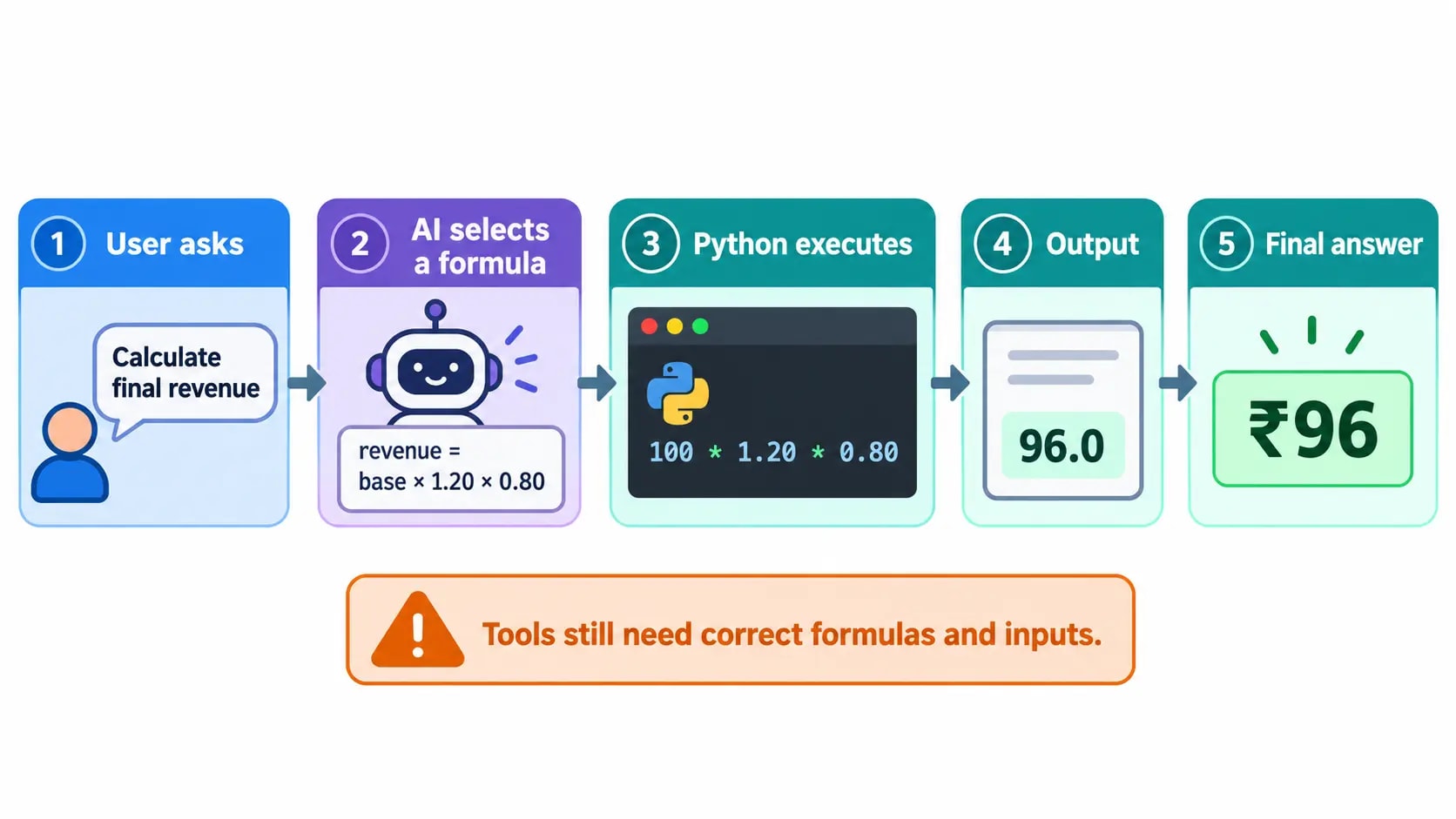
Imagine asking an AI to multiply two large numbers.
Instead of relying entirely on generated calculations, an AI system with access to a calculator or code-execution tool can perform the calculation directly.
For example:
starting_revenue = 100
after_increase = starting_revenue * 1.20
final_revenue = after_increase * 0.80
print(final_revenue)  # 96.0
The computer executes the calculation. This can reduce arithmetic mistakes when the formula and inputs are correct.
But if we write the wrong formula, the computer will execute that wrong formula.
Tools make checking easier. They don't remove the need to understand what we're checking.
What about testing code?
Suppose an AI writes a function that sorts a list.
We can run the function against several tests.
Does it work with an empty list?
What about duplicate numbers?
What about negative numbers?
If a test fails, a tool-enabled coding agent can inspect the failure and try another solution.
This can happen during inference without changing the model's parameters.
Does every task need a reasoning model?
No.
For a simple grammar correction or short translation, a fast model may be enough.
For a difficult mathematics problem, complex code debugging, or planning a task with many constraints, extra reasoning and verification may help.
The right amount of computation depends on the task. More isn't automatically better. What matters is whether the extra work improves the result.
8. So, can AI really think?
We've traveled a long way.
We began with a simple percentage problem and discovered how a quick answer could be wrong.
Then we saw how AlphaGo learned from human examples, self-play, reinforcement learning, and search.
We learned that language models can use intermediate steps as a scratchpad.
We explored how reinforcement learning with verifiable rewards can improve performance on checkable problems.
We saw how reasoning models such as OpenAI o1 and DeepSeek-R1 use training and additional inference-time computation to approach difficult tasks.
And finally, we discovered that longer explanations don't automatically prove correctness.
So, can AI really think?
That depends on what we mean by thinking.
If we mean solving difficult problems, planning steps, checking calculations, exploring different approaches, and correcting some mistakes, modern reasoning models can demonstrate these abilities. We can test their performance and measure how well they solve problems.
But if we're asking whether AI experiences thoughts or feelings the way humans do, that's a different question. Solving problems doesn't, by itself, establish conscious experience.
For this chapter, we're focusing on what we can observe:
How AI works through problems, and how reliably it reaches the right answer.
Imagine two students sitting in an exam.
One quickly writes down the first answer that comes to mind.
The other works through the problem, checks a calculation, notices a possible mistake, and corrects it.
The second student may have a better chance of getting the right answer.
But what if the second student misunderstood the question?
Even ten pages of calculations might lead to the wrong result.
That's the lesson of reasoning models.
Reasoning doesn't make mistakes impossible. It gives AI more ways to work through problems—and sometimes catch mistakes before answering.
9. What happens when we give AI tools?
So far, we've explored how AI can answer questions and work through problems.
Now imagine giving it a bigger task:
Build a small website that tracks my daily expenses.
To complete this, an AI system might need to plan several steps.
Create project files.
Write code.
Run the application.
Read error messages.
Fix problems.
Test the result.
And repeat some of these steps when necessary.
When an AI system can use tools and take actions toward a goal, we're entering the world of AI agents.
An AI agent isn't simply a model producing one answer. It's a system built around a model, with tools, instructions, and a process for deciding what to do next.
And that raises a new question:
What happens when AI doesn't just explain how to do something, but can actually perform some of the steps?
That's where our next chapter begins.
Next episode: What Are AI Agents? From Chatbots to Systems That Take Action.
Your One-Minute Snapshot
Concept | What to remember |
|---|---|
System 1 vs System 2 | An analogy for fast intuition and slower deliberate thinking in humans—not literal AI systems. |
AlphaGo | An AI that combined expert examples, neural networks, self-play, reinforcement learning, and search. |
Move 37 | AlphaGo's surprising move during Game 2 against Lee Sedol in 2016. |
Self-play | Learning by playing games against versions of oneself and using outcomes as feedback. |
Chain-of-thought (CoT) | Intermediate reasoning steps generated while working through a problem. |
Chain-of-thought prompting | Giving examples of intermediate steps to encourage step-by-step solutions. |
Scratchpad | Generated intermediate information that later predictions can use. |
Reinforcement learning | Improving a model using rewards or feedback from generated actions or responses. |
RLVR | Reinforcement Learning with Verifiable Rewards, using checkable outcomes such as math answers or code tests. |
Inference-time compute | Computing resources spent while generating an answer using trained parameters. |
Reasoning model | A model trained to perform better on complex problem-solving tasks, often using intermediate computation. |
OpenAI o1 | A reasoning model introduced in 2024 and trained with reinforcement learning. |
DeepSeek-R1-Zero | A model trained with reinforcement learning without an initial supervised fine-tuning stage for reasoning. |
DeepSeek-R1 | A reasoning model trained using multiple stages of supervised fine-tuning and reinforcement learning. |
CoT faithfulness | Whether generated reasoning reflects the information that influenced the answer. |
Tool-assisted verification | Using code execution, tests, calculators, or other tools to help check answers. |
AI agent | A system built around an AI model that can use tools and take actions toward a goal. |
The main takeaway: More reasoning can improve difficult problem-solving, but longer explanations and extra computation do not guarantee correct answers.
Research and further reading
The important historical and technical claims in this chapter are grounded in these primary sources:
Google DeepMind — AlphaGo — AlphaGo's learning process, Move 37, and the Lee Sedol match.
Google Research — Chain-of-Thought Prompting (2022) — Improvements from intermediate-step prompting.
OpenAI — Learning to Reason with LLMs (2024) — OpenAI o1, reinforcement learning, and inference-time computation.
DeepSeek-R1 Technical Report (2025) — DeepSeek-R1-Zero and DeepSeek-R1 training methods.
Anthropic — Reasoning Models Don't Always Say What They Think (2025) — Research on chain-of-thought faithfulness.
The mathematical, classroom, and programming examples are educational illustrations rather than descriptions of individual model experiments.